
Rental Advice
The 6 Moments That Catch Visiting Drivers Off Guard in the US
Four-way stops, right turns on red, unprotected lefts, freeway exits, school buses and pedestrians: everyday scenes on American roads that work differently from home. Here's how to handle each one, and how FSD (Supervised) can help.

Driving in the US
Different rules. Don't trust instinct.
Driving a rental car in the US isn't hard. What makes visitors nervous are the moments that work differently from home: a stop sign, a right turn on red, a school bus pulling over. When the rules are unfamiliar, instinct leads you the wrong way. These six situations are the ones our guests ask about most and the ones most likely to end in a ticket or a scrape. Each comes with a one-line fix. The rules below follow California, and most states are similar.
1. Four-way stops: first to arrive, first to go
Many residential intersections have no traffic light, just a red STOP sign facing each direction. There are only three rules:
- 1Come to a complete stop. Wheels still, count one second, then look. Rolling through slowly doesn't count, and California police watch for exactly that.
- 2Whoever stopped first goes first. If two cars arrive together, the one on the right goes.
- 3If someone is waiting to cross, the pedestrian always goes first.
When you're not sure whose turn it is, waiting an extra second costs nothing. The other driver will usually wave you through.
2. Right turn on red: allowed, but stop first
In California you may turn right at a red light unless a sign says NO TURN ON RED. But allowed doesn't mean just go. The order is: stop fully at the line, check for traffic from the left, check the crosswalk for pedestrians, and only then turn.
3. Unprotected left turns: a green light isn't a green arrow
When the signal shows a round green light rather than a green arrow, a left turn must yield to oncoming traffic and to pedestrians crossing. Your light is green, but so is theirs, and whoever is going straight has the right of way.
The technique: pull into the intersection and wait in the middle, keeping your wheels pointed straight, until there's a real gap in oncoming traffic. If the light turns yellow and oncoming cars stop, you finish the turn. That's legal.
Some intersections post a sign reading LEFT TURN YIELD ON GREEN. It's there for exactly this reason.
4. Freeway exits: if you miss it, take the next one
Southern California freeways are wide and busy, with five or six lanes as the norm, and the far-right lane often turns into an EXIT ONLY lane that carries you off whether you meant to leave or not. On your first drive, check the navigation two miles ahead, stay in a middle lane, and move right only as the exit approaches.
Missed it anyway? Keep going, take the next exit and loop back. It usually costs five minutes. Never brake hard at the exit and never cut across three lanes at once. Those two moves cause more freeway collisions than anything else.
- Before every lane change: signal, check the mirror, then glance over your shoulder at the blind spot. All three, then move.
- One lane at a time. Settle in, then move again.
5. School buses and emergency vehicles: everyone stops
This is the rule visitors miss most often, and the one with the heaviest fines. When a yellow school bus stops with its red STOP arm out and lights flashing, traffic behind it stops, and traffic coming the other way stops too, until the arm folds back in. The only exception is when a physical median or a divided road separates the two directions.
When you hear a siren or see an ambulance, fire truck or police car coming up behind you with lights on, pull to the right, slow down and stop to let it pass. When you pass a police or rescue vehicle already stopped on the shoulder with its lights on, move over one lane, or slow down noticeably if you can't.
6. Pedestrians and cyclists: they always have the right of way
In the US, the moment a pedestrian steps into a crosswalk, every car stops. Not slows, stops. At corners without a painted crosswalk, pedestrians still have priority. Many California crossings have flashing pedestrian beacons; when they flash, you stop.
After parking at the curb in town, check the mirror and look back before opening your door, especially on streets with a bike lane. Cyclists move fast, and a door swinging open is a collision. Open the door with the hand farthest from it and your body turns naturally to look behind. It's a small habit worth keeping.
A few more rules that are easy to miss
- Speed limits are in miles per hour. 65 mph is about 105 km/h; city streets are usually 25 to 35 mph, and school zones are 25 mph when children are present.
- The far-left freeway lane marked with a diamond is the carpool lane. You need at least two people in the car to use it, and solo drivers get a hefty fine.
- Curb colors are parking rules: red means no stopping, white is passenger loading only, yellow is for loading goods, green is time-limited, and blue is reserved for disabled permits.
- Phones are hands-free only. Being seen holding one while driving is a ticket.
- Orange County has several electronic toll roads with no toll booths. Driving them charges the vehicle automatically, and the fee is billed to the rental company and passed on to you.
How FSD (Supervised) helps
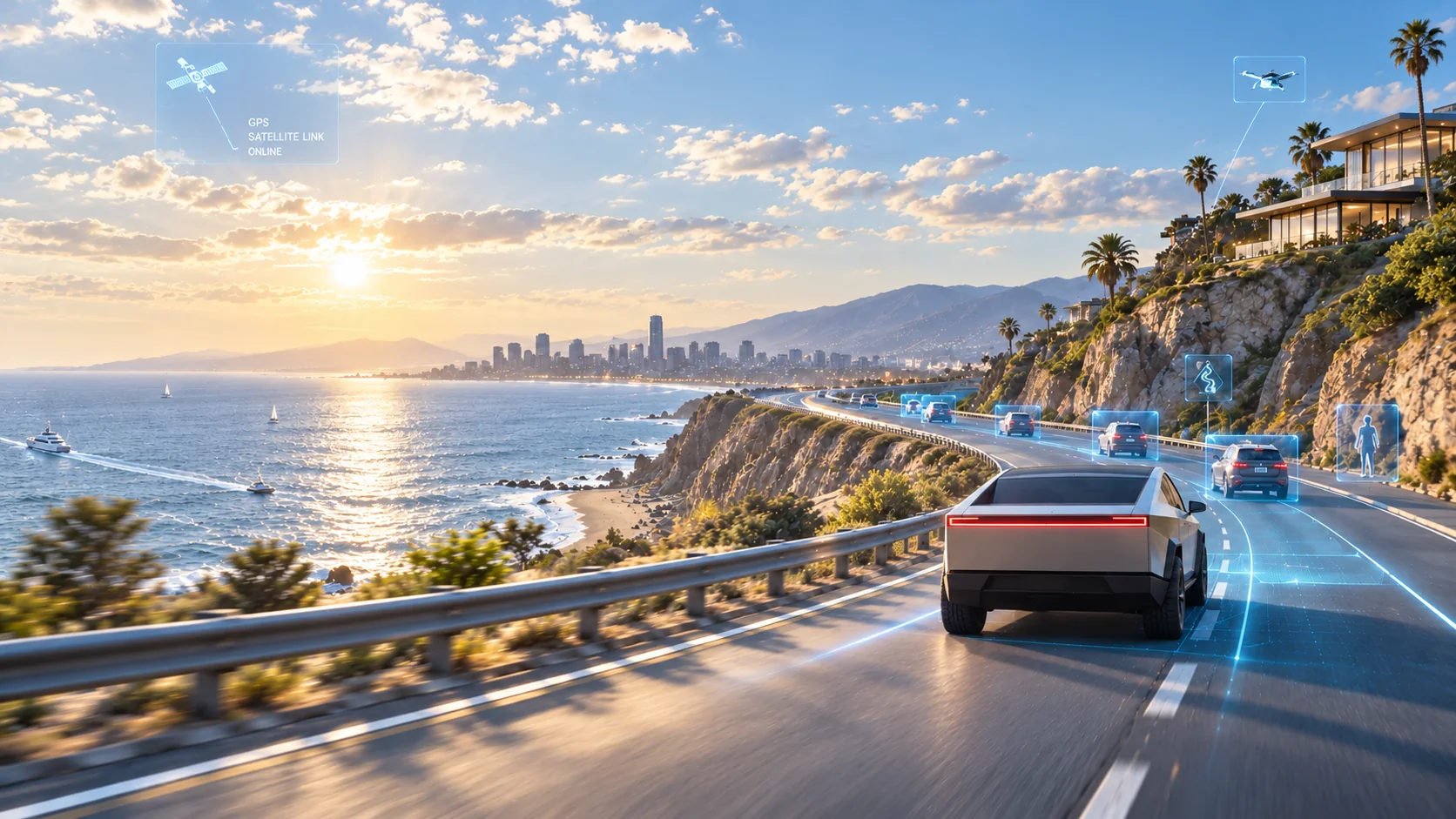
These six moments have one thing in common: the problem isn't driving skill, it's unfamiliar rules and not enough attention to go around. That's exactly where Full Self-Driving (Supervised) is at its best. Every Movia car includes it, and once it's on:
- It comes to a full stop at stop signs before moving on. It never rolls through.
- At a red light it stops before turning right and checks for pedestrians and cross traffic.
- On an unprotected left it waits in the intersection for a real gap in oncoming traffic.
- Following the navigation, it moves into the correct exit lane early instead of braking late or cutting across.
- When someone is in a crosswalk, it stops and waits.
- Before changing lanes it checks the blind spot with cameras all around the car, which see more than a glance over your shoulder.
But remember the word in the name: Supervised. It's a very rule-abiding co-driver, not a driver who takes responsibility for you. You still watch the road, keep your hands on the wheel and stay ready to take over, and school buses and emergency vehicles are moments to judge for yourself. Know the rules, because the ticket and the responsibility are still yours.
Ready to go
You know the rules, and the car helps you keep them. The rest is the view out the window. Pick a car, and we'll see you in Irvine.