
California Travel
2026 Las Vegas F1 Grand Prix: A Practical Tesla Road Trip Guide
Heading to the 2026 Las Vegas Grand Prix in a Tesla? Here's a clear guide to the dates, drive, charging, hotel strategy, event traffic, and smart FSD use.

Las Vegas
Race weekend starts on the I-15.
If you're planning to see the 2026 Las Vegas Grand Prix and you're thinking about driving from Southern California in a Tesla, this is actually a very easy trip to do well.
The route is familiar, Tesla charging is straightforward, and during F1 weekend it's often easier to arrive with your own plan than to keep juggling flights, rides and hotel logistics.
This guide keeps it simple: when to go, how to drive it, where to charge, where to stay, how to deal with race-week traffic, and how to use FSD (Supervised) in a smart way.
01 | First, lock in the timing
According to Formula 1's official calendar and the Las Vegas Grand Prix FAQ, the 2026 Las Vegas Grand Prix runs from November 19–21, 2026. The event takes place on the Las Vegas Strip Circuit, with the start/finish area at Grand Prix Plaza near Harmon Avenue and Koval Lane.
In simple terms:
- Thursday, Nov 19: practice sessions
- Friday, Nov 20: practice + qualifying
- Saturday, Nov 21: race day, with the Grand Prix scheduled for 8:00 PM local time
This is one of the signature night races on the calendar, and that is a big part of why Vegas feels so different.
02 | Why driving a Tesla actually makes sense
A lot of people immediately think about flying to Vegas. But if you're already in LA, Orange County, or the Inland Empire, driving a Tesla is a very practical option.
Here are the main reasons.
1. More freedom with luggage
An F1 weekend usually means more than just showing up for the race. You'll probably stay two or three nights, bring layers for the evening, comfortable shoes, chargers and maybe leave room for merch.
Driving yourself is simply easier.
2. The charging route is mature
The I-15 corridor is already one of the easiest Tesla road-trip routes in the region. Baker and Primm are major charging stops, and once you're in Las Vegas, there are multiple charging options in and around the city.
3. FSD (Supervised) helps most on the boring part
The tiring part of the trip usually isn't Las Vegas itself. It's the long highway stretch getting there. On that kind of drive, FSD (Supervised) and Tesla's driver-assistance tools can help reduce fatigue when used correctly.
4. Your return trip stays flexible
You can leave the next morning, stay another night, stop at an outlet, or make the drive home on your own schedule. You're not locked into a flight.
03 | What to sort out before you leave
Book tickets and hotel early
The biggest Vegas F1 mistake is waiting too long.
As race week gets closer, hotel pricing and location value can change fast.
If you know you're going, try to lock in:
- your ticket / package
- your hotel
If it's your first time and you want the full atmosphere, staying near the Strip is the easiest choice. If you care more about driving ease, parking and price, staying a little farther from the core can be a better move.
Don't leave charging strategy for later
Start with a healthy battery, especially if you want to get to your hotel and avoid immediately going out again to charge.
A common approach is:
- leave with around 90%
- charge normally on the route
- once in Vegas, confirm whether your hotel has charging
If possible, choose your hotel with EV convenience in mind
Try to prioritize at least one of these:
- on-site EV or destination charging
- valet that handles EVs well
- easy self-parking access
- no need to drive far just to charge
On race weekend, late-night extra charging errands get old quickly.
04 | Charging from Southern California to Vegas
Keep this part simple.
The easiest rule is: let in-car navigation do the detailed work, but know the major charging anchors.
Useful charging stops
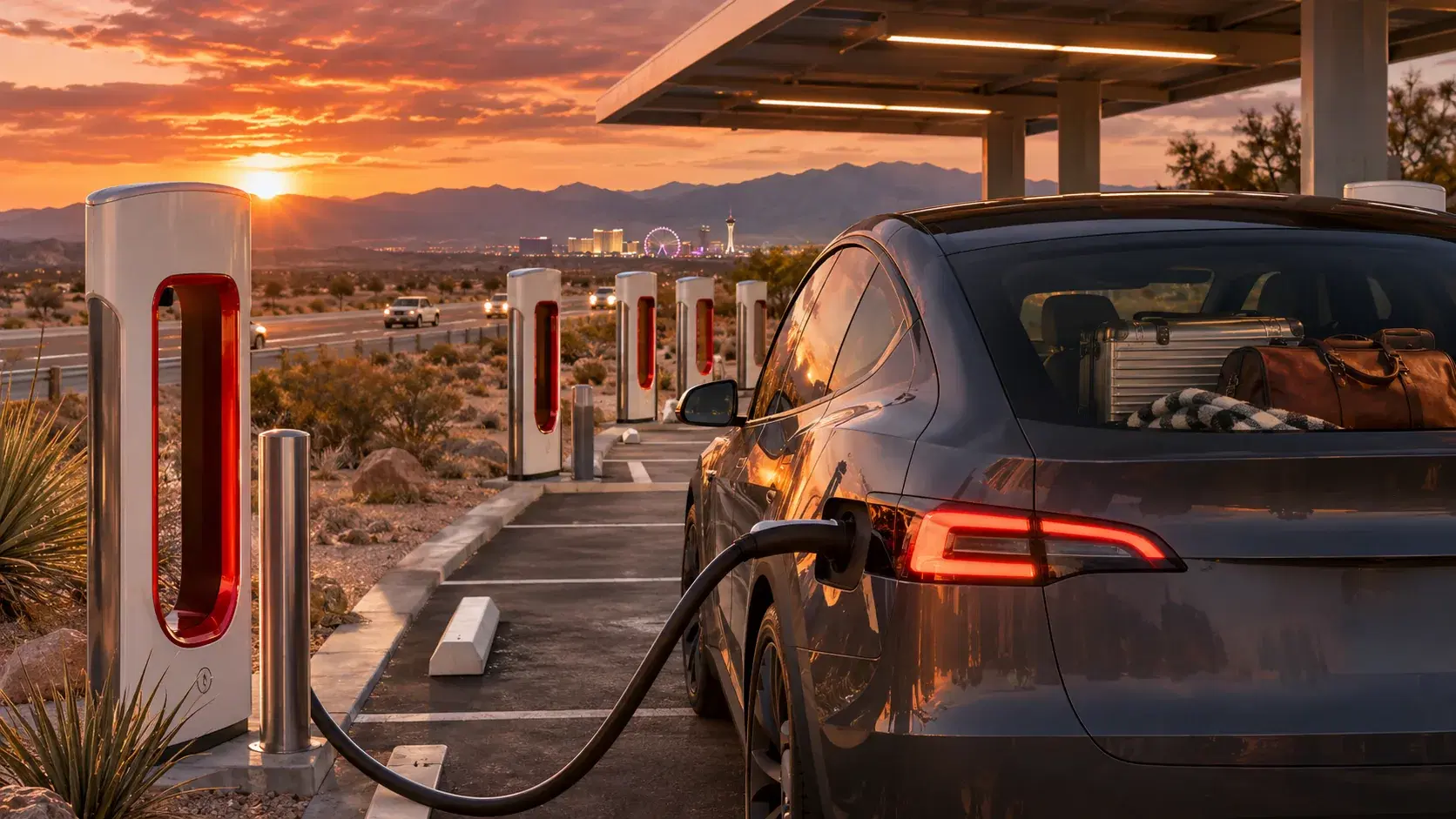
Based on Tesla's official location information, common options include:
- Baker, CA — Shell, 96 Superchargers, up to 250kW
- Primm, NV — Primm Valley Casino Resorts, 42 Superchargers, up to 250kW
- Las Vegas Convention Center – Silver Lot 3 — 12 Superchargers, up to 250kW
- Boulevard Mall — 28 Superchargers, up to 325kW
- M Resort, Henderson — 24 Superchargers, up to 250kW
For most drivers coming from LA or Orange County, Baker and Primm are the classic road-trip stops.
A very practical tip: if you expect race-week traffic in Las Vegas to be messy, it helps to arrive with more battery than usual.
Once you're in town, a short distance can still take time.
05 | Where should you stay?
There isn't one perfect answer, but there are two clear strategies.
Option A: Stay near the Strip
Best for:
- first-time Vegas F1 visitors
- people who want the atmosphere
- people who would rather walk more and drive less
Pros: closer to the event, stronger race-week energy. Cons: more expensive, more traffic, slower in and out.
Option B: Stay a bit off the Strip
Best for:
- people driving themselves
- people who care more about value
- people who want easier parking
Pros: usually cheaper and easier to manage. Cons: slightly more commute planning.
If you're already driving a Tesla in, a very balanced choice is this:
stay somewhere not too far from the race, but not trapped in the most congested core.
06 | Once you're in Vegas, what's the smartest way to use the car?
This is where a lot of people overcomplicate things.
Just because you drove to Las Vegas doesn't mean you should keep moving the car around all weekend.
In most cases, the easiest strategy is:
drive in, park smart, and then move the car as little as possible.
That is because race week around Las Vegas Blvd, Harmon, Koval and Sands usually means:
- traffic controls or detours
- very heavy pedestrian flow
- slow hotel and parking-lot access
- lots of route changes
If your hotel is very close, it often makes sense to leave the car and rely on:
- walking
- rideshare
- monorail / public transit if your location works well for it
If your hotel is farther out, you can still drive part of the way—but it is usually best to park once in a manageable area and finish the rest on foot or with local transport.
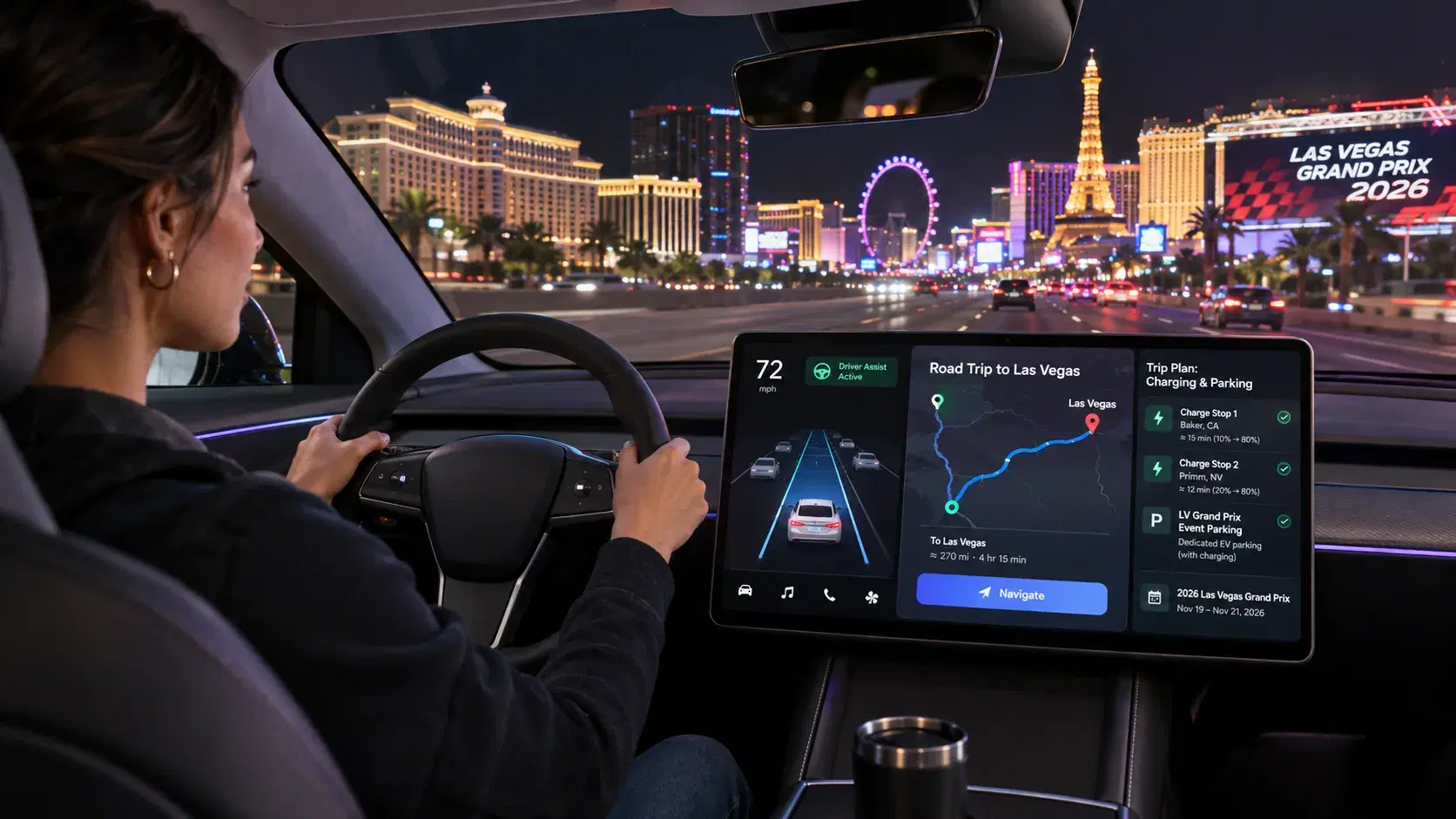
07 | How should you use FSD (Supervised) during race weekend?
The short answer:
great for the highway, don't lean on it too much near the circuit.
Good use cases
- long I-15 highway stretches
- ordinary main roads in and out of Las Vegas
- stable traffic with clear lane markings
Situations where manual driving is the better call
- temporary event detours
- construction or cone-heavy traffic control areas
- hotel entrances, valet lanes and parking garages
- slow, crowded pedestrian zones
- visually busy night environments with lots of reflections and lighting
Vegas F1 traffic is not difficult because it's technically complex.
It's difficult because it changes fast and there is a lot going on.
So the best strategy is:
- use FSD (Supervised) to reduce fatigue on the highway
- take over early and drive manually around the race zone
That is usually the smoothest balance.
08 | A simple weekend plan that works well
If it's your first time, keep it easy.
Arrive Thursday
- leave Southern California earlier in the day
- charge on the way
- check into the hotel
- spend the evening learning your surroundings
Use Friday well
A lot of first-timers end up loving qualifying.
Because Vegas is a night race, qualifying carries a lot of atmosphere and can feel slightly easier to manage than race night.
Leave extra time on Saturday
Even though the race is at night, don't make the mistake of thinking you can wait until the last minute.
What you really need to budget for is:
- traffic getting toward the venue
- walking time
- security and entry
- finding your section, food and restrooms
Earlier is easier.
09 | What should you keep in the car?
Simple things help:
- charging cable
- power bank
- jacket or hoodie
- comfortable shoes
- water
- simple snacks
- sunglasses for daytime
- ticket / app / hotel confirmations
And remember: Vegas may feel warm during the day, but November nights around the race can feel cooler than people expect.
10 | The short version
If you want a smooth 2026 Vegas F1 trip, focus on these basics:
- book hotel and tickets early
- think about parking and charging when choosing where to stay
- arrive in Vegas with comfortable battery margin
- use FSD (Supervised) on the long highway drive, not as a crutch near the race zone
- move the car as little as possible once you're close
- leave earlier than you think on race day
That alone will make the weekend much easier.
And if you want the trip to feel even more seamless, this is exactly the kind of weekend where renting the right Tesla helps.
At Movia, we offer Tesla FSD (Supervised) vehicles that are especially well suited for road trips like Southern California → Las Vegas → race weekend → drive back.
Not because it sounds flashy—but because it genuinely makes the trip easier, calmer and more enjoyable.
More Life Between Destinations.